AI Works Best When It Changes the Operating Rhythm
Most AI pilots end at the demo. This one became a daily sales coaching email — and made follow-up gaps harder to ignore.
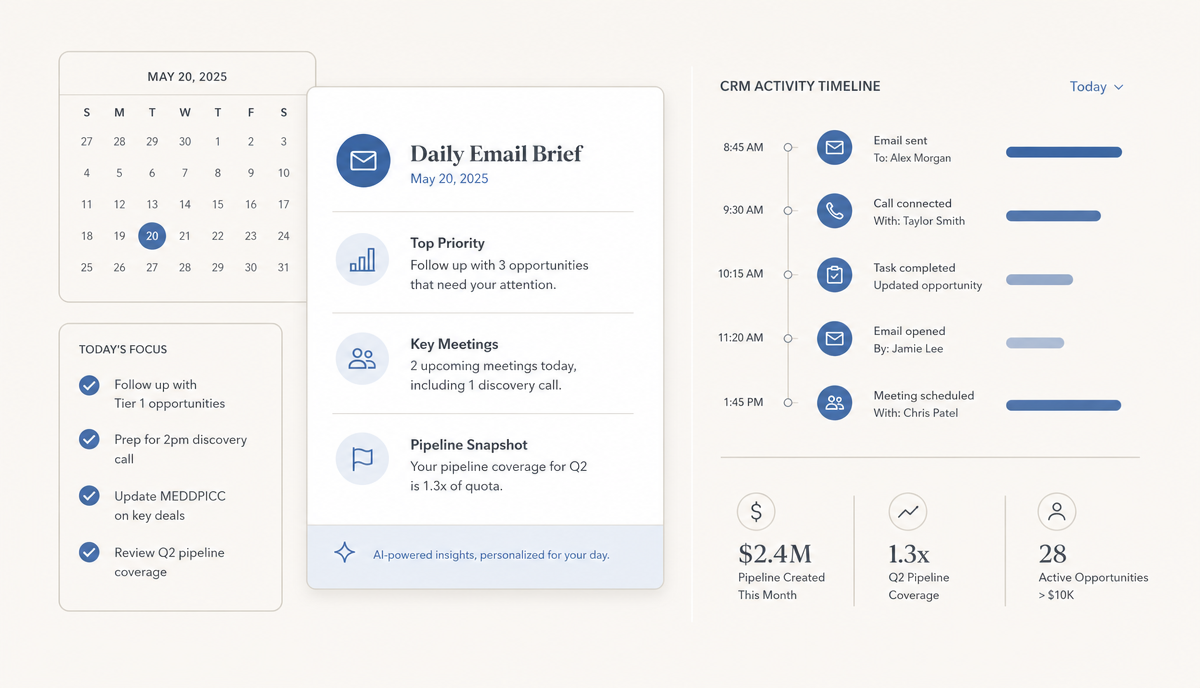
Most AI demos are impressive for about five minutes.
Someone types a prompt. The model produces a sharp answer. Everyone nods. Then the meeting ends, the team goes back to work, and nothing about the business actually changes.
That is the gap I care about.
The useful question is not "can AI write something clever?" It can. The useful question is whether AI can be wired into the daily operating rhythm of a business in a way that improves behavior, exposes gaps, and helps managers act sooner.
One of the better examples I have worked on recently was with a private aviation client. The business already had salespeople, a CRM, marketing campaigns, website traffic, and a deep market of aircraft operators and customers. The problem was not a lack of tools. The problem was that the operating picture was scattered.
Sales activity lived in Pipedrive CRM, email, calendars, calls, campaign systems, and manager conversations. If someone wanted to know what changed yesterday, which deals were getting stale, which customers had been touched, or which rep needed coaching, they had to go hunt for it.
That kind of work sounds small until you watch it happen every morning.
A manager opens the CRM. Checks overdue activities. Looks for deals with no next step. Checks yesterday's calls. Looks at email follow-up. Tries to remember which customer was waiting on a quote. Then turns that into coaching for each salesperson.
It is valuable work. It is also exactly the kind of work that gets skipped when the day gets busy.
What We Built
We built an AI-enabled sales coaching workflow around Pipedrive CRM data.
The system pulls CRM activity and generates daily coaching emails for the sales team and managers. Each email is structured around the questions a sales leader would normally ask:
- What happened yesterday?
- Which calls, emails, and meetings were logged?
- Which activities are overdue?
- Which open deals have no next step?
- Which deals are getting stale?
- Where should the rep focus today?
- What is the quick win?
The important part is that this is not just "Claude in someone's hands." It is not a salesperson asking a chatbot what to do. It is a workflow connected to the system of record, producing a daily operating brief from real CRM data.
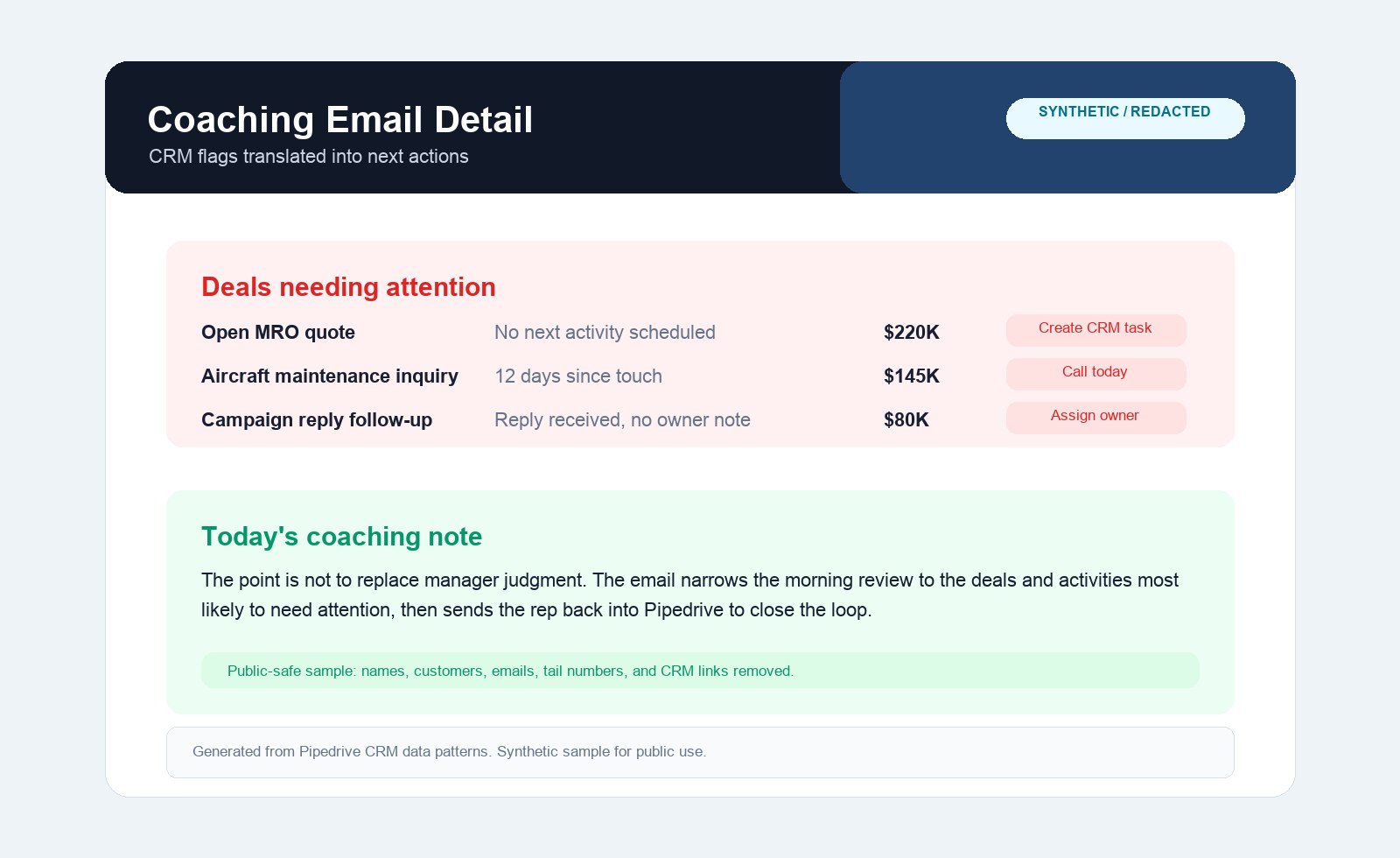
The email does not replace the CRM. It points people back into it. It does not close deals, launch campaigns, or edit records on its own. It gives managers and reps a clearer morning view of what deserves attention.
This was not an autonomous agent. It was a bounded workflow: it read CRM data, produced a brief, and left decisions and record changes to people. That was a feature, not a limitation.
What a Brief Looks Like
A typical coaching email is short and specific. It might flag three deals without next steps, an overdue quote, and a customer who had not been contacted in two weeks — then link directly to each Pipedrive CRM record.
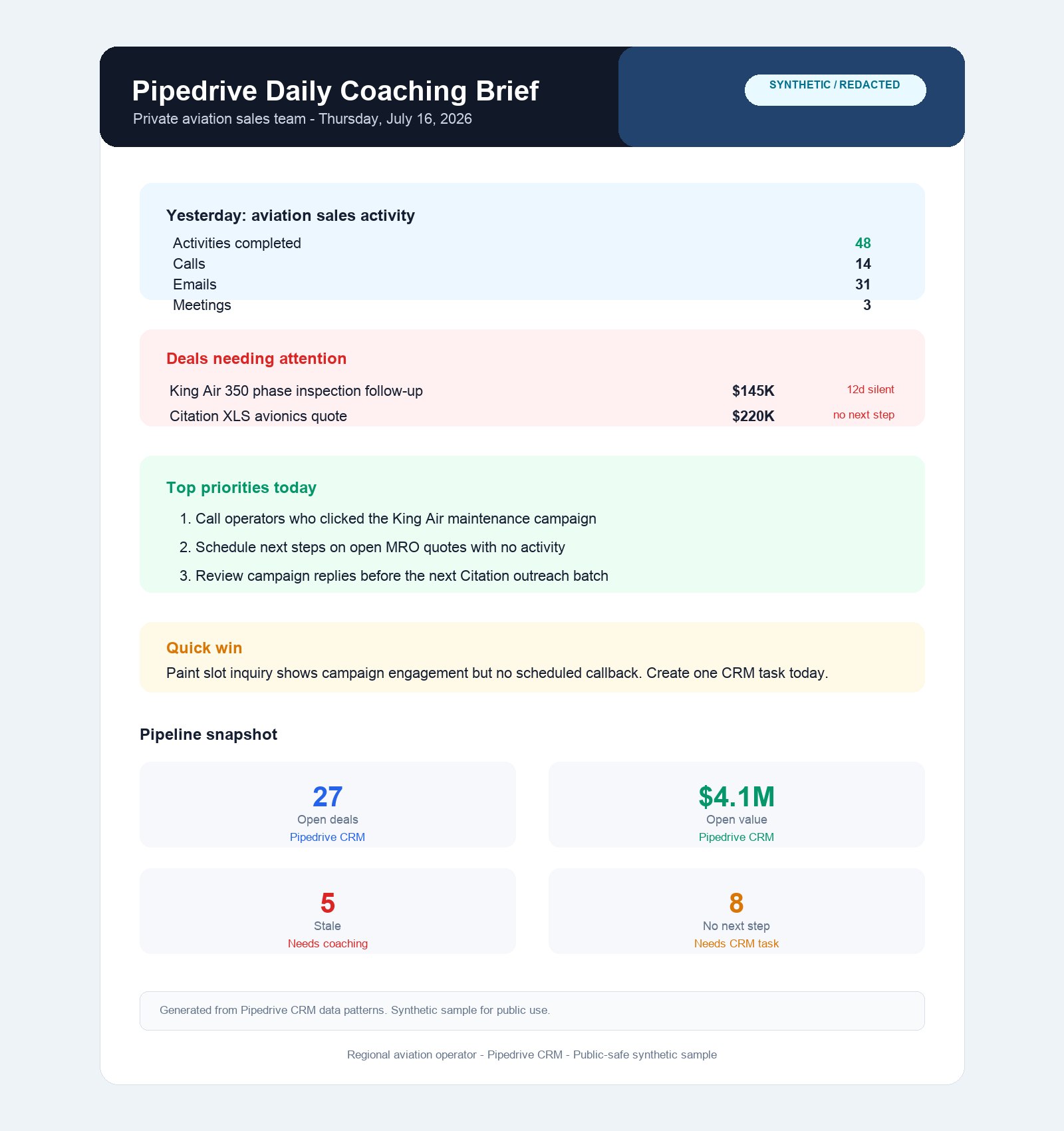
The rep does not have to interpret a dashboard or remember a report. They open the email, click the links, and act. The manager has the same view, so coaching becomes a conversation about the same facts rather than a game of "did you follow up?"
Why the Email Was the Right Surface
Dashboards are useful, but they require someone to go look. Email is different: it shows up where the workday already starts.
For this client, the goal was not to create another portal. The goal was to make the right sales questions unavoidable. A good coaching email gives a manager a short list of things to inspect and gives a rep a clear set of priorities before the day takes over.
The best version of this kind of AI is quiet. It does not announce itself as transformation. It just removes the daily friction between data and action.
What Changed
During the Q1-to-Q2 rollout, the operating metrics moved materially: logged Pipedrive CRM activity increased 71%, calls 64%, emails 88%, and unique people touched 120%.
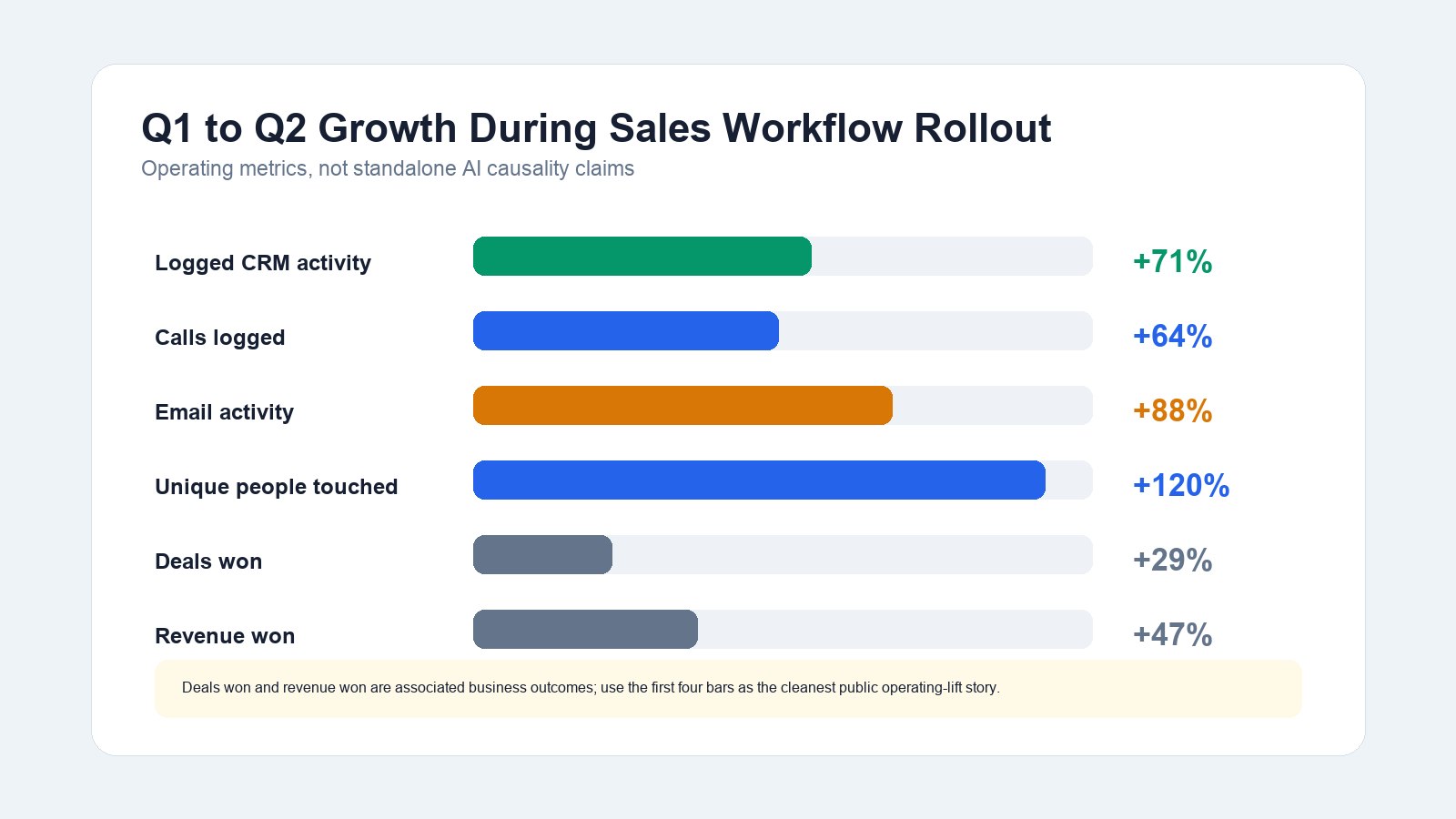
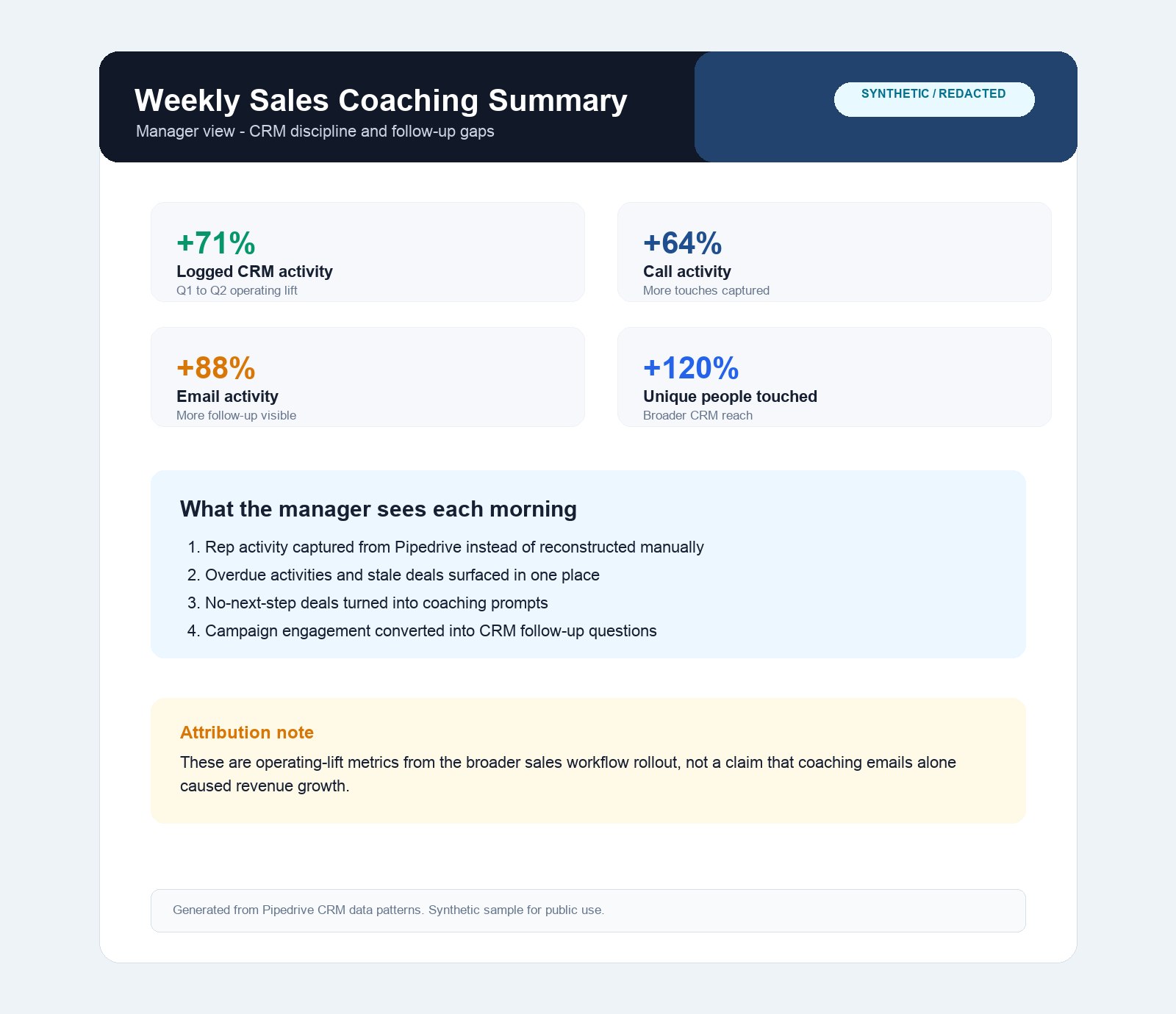
Some of that lift may reflect better activity capture rather than entirely new activity — but improved visibility was itself one of the goals.
Those are operating claims rather than revenue claims.
That matters because operating metrics are often the honest first proof point for AI work. Before you can claim revenue impact, you need to show that the system changed behavior:
- More activity was captured.
- More customers and prospects were touched.
- More follow-up gaps became visible.
- More stale deals could be identified.
- Managers had a repeatable coaching surface instead of a manual morning scavenger hunt.
During the same period, won deals and revenue also improved. That is useful business context, but I would not claim the AI workflow caused that by itself. Sales outcomes are affected by people, market timing, campaigns, pipeline quality, and management focus.
The more defensible claim is this: the AI-enabled workflow improved the operating cadence around sales activity, visibility, and follow-up discipline.
The Hard Part Was Not the Email
The email was the visible artifact. The hard part was the plumbing underneath it.
To make a daily coaching email useful, the CRM has to be trustworthy enough to coach from. That meant paying attention to email sync, calendar sync, mobile call logging, activity capture, owner mapping, pipeline stages, stale thresholds, and links back to the right Pipedrive CRM records.
It also meant accepting that some data would be messy.
Some activities were not linked cleanly to deals. Some fields were available in one Pipedrive CRM API endpoint but not another. Some sales behavior had to change before the reporting could become reliable. The AI could summarize gaps, but it could not magically repair every missing input.
That is another lesson worth keeping: AI does not remove the need for operational discipline. It rewards it.
The better the system of record, the better the coaching. The worse the data, the more the AI becomes a mirror showing you what needs to be fixed.
The Bigger Lesson
For executives looking at AI, I would pay less attention to the flashiest demo and more attention to the workflow that survives Monday morning.
Can it connect to the systems where work already happens?
Can it produce a useful artifact without someone crafting a perfect prompt?
Can it make gaps visible earlier?
Can it help a manager coach better, faster, and with more evidence?
Can it stay inside sensible approval boundaries?
That is the difference between AI as a novelty and AI as an operating layer.
The coaching emails worked because they did not ask the business to believe in magic. They asked the business to look at yesterday's CRM activity, today's open gaps, and the next actions that deserved attention.
If an AI system cannot survive Monday morning — using real data, fitting an existing habit, and staying inside clear boundaries — it has not changed the operating rhythm yet. It is still a demo.
Subscribe
Get the next one in your inbox.
Roughly monthly. No tracking, easy unsubscribe.
Related reading
From Read-Only to Responsible Action: Rebuilding the Pipedrive CRM MCP Server for 2.x
Version 2.x rebuilds the Pipedrive CRM MCP Server around modern APIs, safer remote access, predictable responses, and a deliberately constrained path from read-only analysis to controlled action.
The Most Useful AI Work Starts Before the Model
Before AI could prioritize aviation prospects, we had to connect the market data, resolve the identities, and make the operating model trustworthy.
I Built a Read-Only Bridge Between AI and Pipedrive CRM
I built an open-source MCP server that lets AI assistants securely search and analyze Pipedrive CRM data using natural language.