AI Answered Every Buying Question — Without the Brand's Own Website
We tested how AI assistants answered real buying questions about two client brands. Both generated useful answers. Only one brand's website helped shape them.
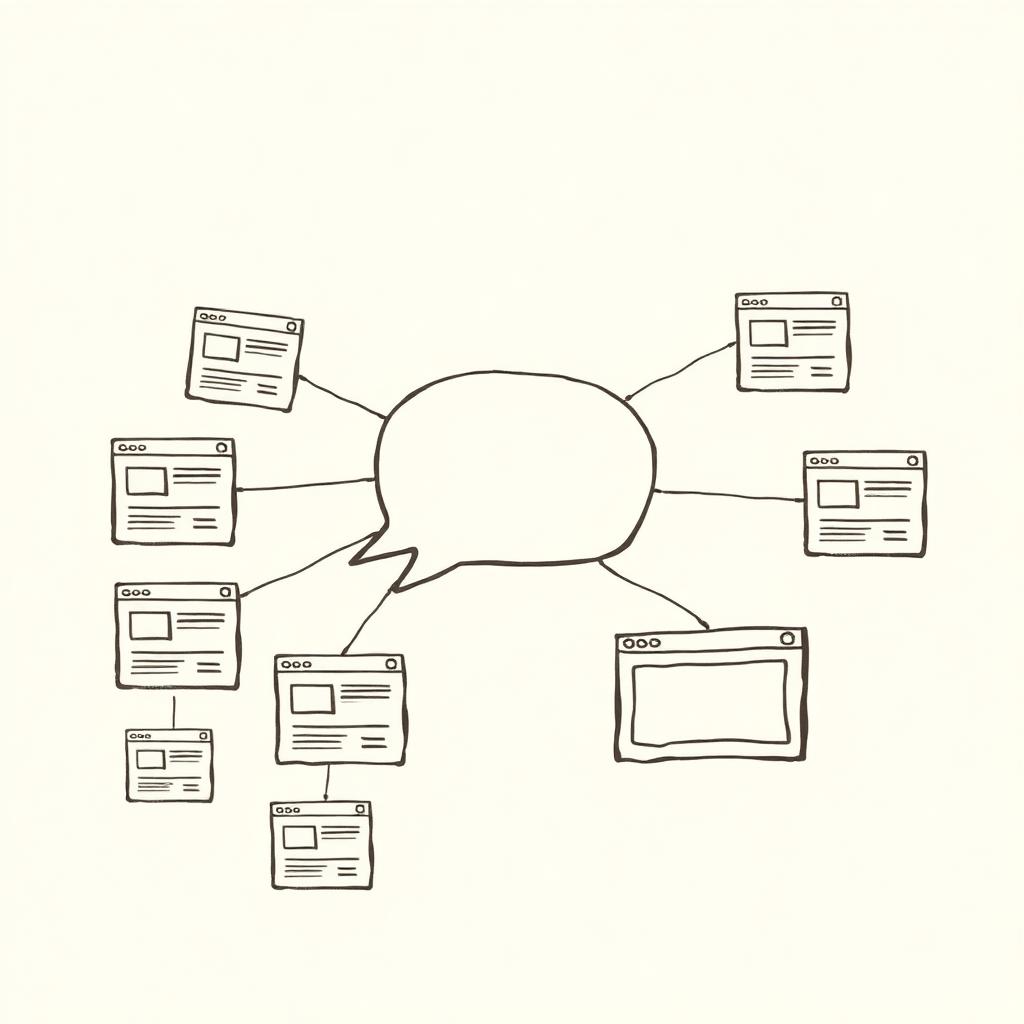
AI-assisted discovery is no longer hypothetical. Customers are already asking AI assistants where to buy, which provider to choose, and which companies carry a particular product.
We recently evaluated how two client brands appeared in those answers.
On July 27, we ran 12 buyer-intent queries using AI assistants with live web access: nine questions for a national consumer brand and three for a regional distributor. The scopes differed because the companies operate in different industries, so this was not a controlled A/B test. It was a point-in-time visibility benchmark designed to answer a practical question:
When AI answers a customer's question, whose information does it rely on?
The difference between the two brands was significant.
Brand one: present in the market, absent as a source
The first company is a category-leading national brand with thousands of provider locations.
Across nine questions about its products and where customers could find them, the assistants produced confident, specific answers. They named local providers and supplied addresses and phone numbers.
But the brand's own website was cited exactly zero times.
The answers were assembled from third-party websites — primarily local providers describing the brand and its products in their own words.
That creates a strategic problem. When the primary brand is not a usable source, resellers, partners, providers, directories, and other third parties define the answer instead. Their information may be accurate, outdated, incomplete, or written primarily to support their own objectives.
Our technical review identified two clear visibility risks.
First, relevant AI agents were being denied access.
We tested both search-indexing and user-directed retrieval agents. The behavior was consistent: the site's bot-protection configuration returned 403 Forbidden.
This was not a complex infrastructure problem. It came down to a setting in the company's bot-protection dashboard.
That does not mean every company should allow every AI crawler. Training crawlers, search-indexing crawlers, and agents retrieving a page on behalf of a user serve different purposes. The important point is that access should reflect an intentional business decision — not an unnoticed configuration setting.
Second, the company's location information was difficult to discover outside its interactive finder.
The map worked for a person clicking through the website, but the underlying locations did not have stable, content-rich pages that search and retrieval systems could reliably discover and cite.
The locations existed operationally. They were simply not well represented as individual entities on the public web.
A competitor had taken the opposite architectural approach, creating thousands of individual location URLs. Its implementation still had a rendering issue that prevented those pages from delivering useful content, but the underlying structure gave it a potentially valuable head start once corrected.
Having pages alone does not guarantee visibility. They still need useful content, reliable rendering, internal links, accurate data, and authority. But without stable pages, a brand has fewer opportunities to become the source of its own facts.
Brand two: the company AI could cite directly
The second company is a regional distributor we have supported on internal agentic workflows and are now helping with external AI visibility.
We asked three questions covering consumer discovery, contractor recommendations, and general company information.
All three answers named the company, recommended it where relevant, and cited information from its own website.
A customer asking where to shop received a showroom recommendation with its location, hours, and product lines. A contractor asking which distributor to work with received information about its trade services. A general company question was answered using the company's own descriptions of its history, brands, and locations.
The company's advantage was not an exotic AI strategy.
Its website allowed the relevant search and retrieval agents to access its content. It also contained more than a thousand stable, factual pages representing locations, product lines, and the brands it carries.
Those pages gave the assistants something authoritative to discover, retrieve, and cite.
This does not guarantee that the company will appear in every AI answer. Results vary by assistant, query, location, source availability, and time. But the company has built the essential foundation: its important business entities exist as accessible, maintainable web content.
Three questions executives should ask
AI visibility is not only a marketing or SEO concern. It sits at the intersection of technology, security, data governance, and customer acquisition.
Here are three questions worth asking your team.
1. Which AI systems can access our public content — and for what purpose?
Do not reduce this to "allow AI" or "block AI."
Inventory the agents reaching your website and distinguish between model training, search indexing, and user-directed retrieval. Decide which uses support your strategy, which should be restricted, and whether your CDN or security rules enforce those decisions correctly.
2. Do the entities that matter to our business have stable pages?
Locations, products, services, brands, professionals, and other important entities should have durable URLs with useful factual content.
Interactive maps and search tools can still provide a good user experience. They should not be the only place the underlying information exists.
The objective is not to generate thousands of thin pages. It is to make important facts available in a form that people, search engines, and AI systems can consistently understand.
3. If our website is not the source, who is telling our story?
AI assistants will still try to answer the question.
If your site is unavailable or difficult to use, they may rely on distributors, directories, partners, social platforms, local operators, and other third parties.
That means your brand can be represented by information you do not own, maintain, or verify.
The answers are already being written
The strategic question is no longer whether AI-assisted discovery will matter.
Customers are already using these tools to research products, compare providers, and decide where to buy. The answers are being assembled now, using whichever sources are accessible, relevant, and understandable.
The companies positioned to benefit will not necessarily be those with the largest marketing budgets. They will be the ones that make accurate information about their business easy to discover and verify.
Try a simple test before your next leadership meeting:
Ask several AI assistants where to buy what your company sells in one of your most important markets. Use fresh conversations and enable live web search. Then look beyond whether your company appears.
Ask which sources shaped the answer.
If your own website is missing, you have found a useful agenda item for your technology, security, and marketing teams.
AIThinkers helps companies measure and improve their visibility across AI-assisted discovery — from crawler access and rendering to the entity pages and factual content underlying AI answers. If you want the same benchmark run on your brand, we can show you what the assistants see.
Subscribe
Get the next one in your inbox.
Roughly monthly. No tracking, easy unsubscribe.
Related reading
From Read-Only to Responsible Action: Rebuilding the Pipedrive CRM MCP Server for 2.x
Version 2.x rebuilds the Pipedrive CRM MCP Server around modern APIs, safer remote access, predictable responses, and a deliberately constrained path from read-only analysis to controlled action.
The Most Useful AI Work Starts Before the Model
Before AI could prioritize aviation prospects, we had to connect the market data, resolve the identities, and make the operating model trustworthy.
AI Works Best When It Changes the Operating Rhythm
Most AI pilots end at the demo. This one became a daily sales coaching email — and made follow-up gaps harder to ignore.